Signal vs WhatsApp vs Telegram: Which Messaging App Is Most Private?
All three apps call themselves private. Only one actually earns that label by default. Here's an honest look at what each app collects, what it encrypts, and who it's built for.
Quick Answer
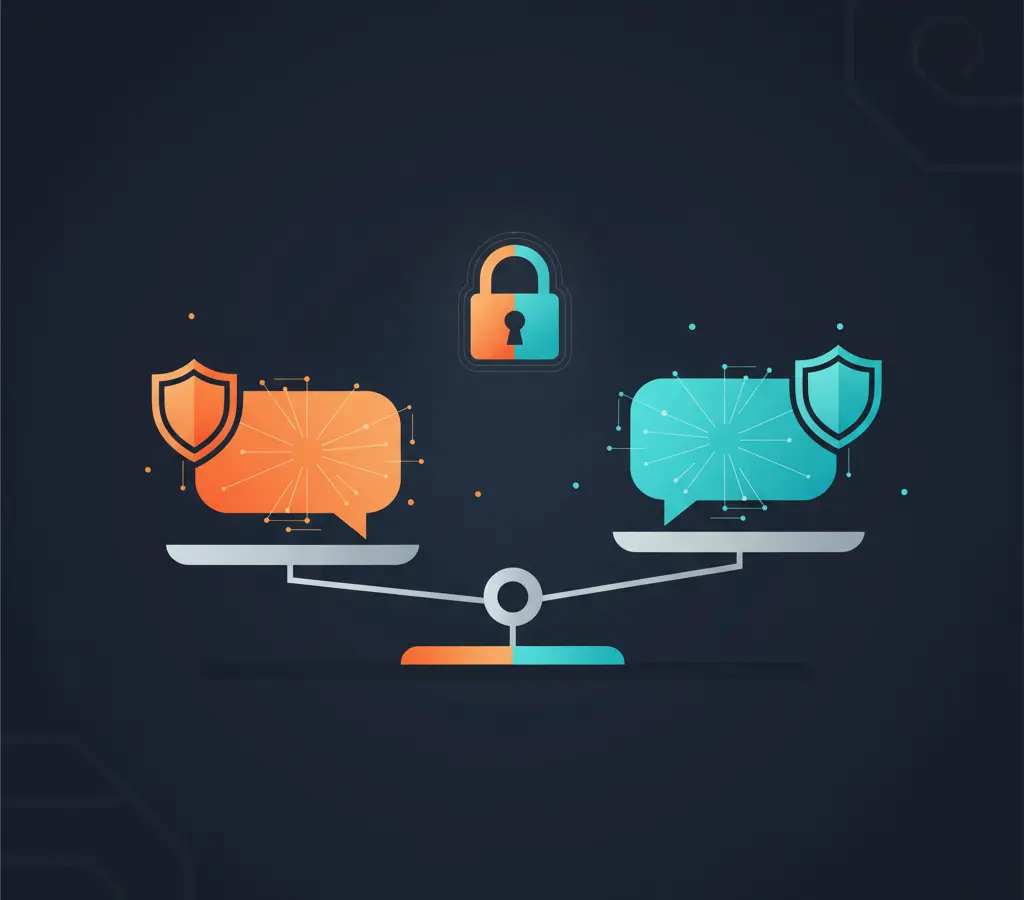
Signal is the most private messaging app by a significant margin — minimal metadata collection, open-source code, and end-to-end encryption on by default for everything. WhatsApp encrypts messages but collects substantial metadata. Telegram's encryption is weak by default and its "private" reputation is largely unearned.
In this article
Key Takeaways
- Signal is the most private option by every measurable standard — minimal metadata, fully open source, and E2E encryption on by default for all chats.
- WhatsApp encrypts message content but collects extensive metadata across 17 data categories for Meta's ad ecosystem.
- Telegram is not end-to-end encrypted by default — regular and group chats sit on Telegram's servers and can be accessed with a legal order.
- Telegram's "Secret Chats" offer E2E encryption but are opt-in, not available for groups, and use a proprietary protocol rather than the audited Signal Protocol.
- The practical answer for most users: Signal for sensitive conversations, WhatsApp where contacts won't move, Telegram only for large communities.
👍 Pros
- Signal: best-in-class privacy with minimal metadata collection and fully open-source code
- WhatsApp: near-universal adoption makes it practical for reaching almost anyone globally
- Telegram: unmatched for large communities, broadcast channels, and bot integrations
👎 Cons
- Signal: smaller user base; still requires a phone number for account creation
- WhatsApp: extensive metadata collection by Meta; backup encryption off by default
- Telegram: not E2E encrypted by default despite widespread reputation otherwise; government cooperation reversed in 2024
Why This Comparison Matters in 2026
“Private messaging” has become a marketing phrase that covers a wide spectrum of actual privacy. All three apps — Signal, WhatsApp, and Telegram — have used some version of the phrase to describe themselves. But the differences between them are significant and consequential, especially as governments in multiple countries have moved to compel message access, and as data broker markets have become more sophisticated.
This comparison covers the four things that actually matter for messaging privacy: default encryption, metadata collection, open-source auditability, and track record when put under legal or government pressure.
Signal: The Privacy Baseline
Signal is the reference implementation for private messaging. Its protocol — the Signal Protocol — is the same one WhatsApp uses for message encryption. But Signal goes further in almost every other dimension.
Encryption: End-to-end encryption is on by default for every message, call, voice note, and media file. There is no non-encrypted mode. Signal also implements forward secrecy (past messages can’t be decrypted even if your key is later compromised) and sealed sender (which hides even the sender metadata from Signal’s servers).
Metadata collection: Signal collects almost none. Their published data model: your phone number (required for account creation), and the date you last connected to Signal. That’s it. There are no read receipts sent to servers, no delivery timestamps logged, no message content stored server-side. Signal’s infrastructure is designed so that even a court order produces almost nothing useful.
Open source: Signal’s client code and server code are both open source and regularly audited by independent security researchers. The app has been reverse-engineered and scrutinized for years without finding meaningful backdoors or data leaks.
Organizational structure: Signal is operated by a nonprofit (Signal Foundation) with no advertising model and no data-monetization incentive. Funding comes from donations and grants.
Weaknesses: Signal requires a phone number to register, which is a real privacy limitation — your phone number is a persistent identifier linked to your real identity in most countries. A username feature was added, allowing you to share a username instead of your number, but account creation still requires a phone number. Group size is capped at 1,000. Some users find the interface spartan. And because Signal’s user base is smaller than WhatsApp or Telegram, you may not be able to move all your contacts there.
WhatsApp: Encrypted Messages, Leaky Metadata
WhatsApp uses the Signal Protocol for message encryption — so message content is end-to-end encrypted between your device and the recipient’s. That part is real and meaningful.
The privacy problem with WhatsApp is everything else.
Metadata collection: WhatsApp is owned by Meta and collects substantial metadata: who you message, how often, at what times, your device fingerprint, IP address, phone’s battery level, signal strength, app usage patterns, and more. This is all documented in WhatsApp’s privacy policy and in Apple’s App Store privacy nutrition label, which shows WhatsApp collects data across 17 categories — compared to Signal’s 1.
Meta has been explicit that it uses WhatsApp metadata to build advertising profiles and improve targeting across Facebook and Instagram, even though it cannot read message content.
Backups: If you back up WhatsApp to Google Drive or iCloud without enabling end-to-end encrypted backup (a setting that is off by default and non-obvious), your message history is stored unencrypted in a cloud service that is accessible by law enforcement with a standard warrant. End-to-end encrypted backup exists and works; most users don’t know to turn it on.
Open source: WhatsApp’s client code is closed source. You cannot independently verify what the app does on your device beyond what security researchers discover through reverse engineering.
Legal record: Meta has complied with thousands of law enforcement requests annually. The response is mostly metadata rather than message content, but metadata alone — who you contacted, when, from where — can be legally damning and practically invasive.
What WhatsApp is good at: Nearly universal adoption in many countries (dominant in Europe, India, Latin America, and large parts of Africa). Feature-complete: high-quality voice and video calls, large group chats, Communities, status updates, business accounts, cross-device sync. If you need to reach almost anyone in many parts of the world, WhatsApp is the practical choice.
Telegram: The Privacy Reputation It Doesn’t Deserve
Telegram is the most misunderstood of the three. Its reputation as a “private” or “secure” app is largely based on marketing rather than technical reality.
Encryption by default: Regular Telegram chats — including all group chats and channels — are not end-to-end encrypted. Messages are encrypted in transit between your device and Telegram’s servers, and then stored encrypted on Telegram’s servers, where Telegram can read them. This is server-side encryption, not end-to-end encryption. Telegram can comply with a legal order by handing over your messages.
Secret Chats: Telegram does have an end-to-end encrypted mode called Secret Chats. It uses a different protocol (MTProto), cannot be used for group chats, does not sync across devices, and is not the default. Most Telegram users have never initiated a Secret Chat. Calling regular Telegram chats “encrypted” without this distinction is misleading.
MTProto protocol: Even in Secret Chats, Telegram uses its own proprietary MTProto protocol rather than the independently audited Signal Protocol. Security researchers have raised concerns about MTProto’s design over the years, though no catastrophic vulnerabilities have been publicly demonstrated in the current version.
Metadata: Telegram collects your IP address, device info, and contact list. By default, your phone number is visible to anyone who has it in their contacts.
Open source: Telegram’s client code is open source, but the server code is not. You can verify what the app sends; you cannot verify what the server does with it.
Legal record: For years Telegram claimed it had never provided user data to governments. In late 2024, founder Pavel Durov acknowledged that Telegram had begun cooperating with legal requests from authorities in multiple countries following his arrest in France. This was a significant shift from Telegram’s prior public stance.
What Telegram is genuinely good at: Very large group chats (up to 200,000 members), public channels, bots, file sharing up to 4GB, and a feature set closer to a small social network than a messaging app. If you run a large community, broadcast channel, or fan group, Telegram is excellent for that use case — just don’t confuse “large community hosting” with “private messaging.”
Side-by-Side Comparison
| Signal | Telegram | ||
|---|---|---|---|
| E2E encryption by default | Yes (all chats) | Yes (message content only) | No (only Secret Chats) |
| Metadata collected | Minimal (phone number + last seen) | Extensive (17 data categories) | Moderate (IP, device, contacts) |
| Client open source | Yes | No | Yes |
| Server open source | Yes | No | No |
| Owned by | Nonprofit (Signal Foundation) | Meta | Private company |
| Revenue model | Donations/grants | Meta ad ecosystem | Premium subscription + ads (planned) |
| Group size limit | 1,000 | 1,024 | 200,000 |
Who Should Use Which App
Use Signal if: Privacy is a genuine priority — you’re a journalist, activist, lawyer, healthcare worker, or anyone communicating sensitive information. Or you simply prefer not to feed your social graph to Meta. Signal is the right default for privacy-conscious users.
Use WhatsApp if: The people you need to reach are on it and aren’t moving. For many users in Europe, India, and Latin America, WhatsApp is effectively the phone system. If you enable end-to-end encrypted backups and understand what the metadata collection means, WhatsApp is an acceptable choice for everyday non-sensitive communication.
Use Telegram if: You want to participate in or run large communities, channels, or bot-based services. Don’t use it under the assumption that your conversations are private by default — they are not. Use Secret Chats if you must have private 1:1 conversations on the platform.
Pros and Cons Overview
Signal strengths: Best-in-class privacy by every measurable metric; open source and independently audited; nonprofit structure with no ad-model conflict of interest; strong voice and video quality.
Signal weaknesses: Smaller user base means you may not reach everyone; requires phone number; interface is functional but not flashy; group size cap of 1,000.
WhatsApp strengths: Near-universal adoption in many countries; feature-complete with calls, communities, and business tools; message content is genuinely end-to-end encrypted.
WhatsApp weaknesses: Owned by Meta; extensive metadata collection; closed-source client; backup encryption off by default; ad-ecosystem revenue model creates structural conflict with user privacy.
Telegram strengths: Excellent for large communities and broadcast channels; generous file sharing; rich bot ecosystem; fast and feature-rich.
Telegram weaknesses: Not end-to-end encrypted by default; proprietary server-side infrastructure; history of misleading privacy claims; founder’s arrest led to policy reversal on government cooperation.
The Bottom Line
If you care about private communication, Signal is the only app in this comparison that was designed from first principles for that goal. WhatsApp is a reasonable choice for everyday use if you accept its metadata trade-offs. Telegram is a community and broadcasting platform that has spent years trading on a privacy reputation it didn’t earn.
The best outcome for most users: Signal as your default for any sensitive communication, WhatsApp for contacts who won’t move, and Telegram only for the large-group or channel features that nothing else matches.
For more on evaluating apps for privacy and security, see our app reviews section or read more about how we approach editorial independence at HogaToga.
Sources
Frequently Asked Questions
No, not by default. Regular Telegram chats and all group chats are stored on Telegram's servers and can be accessed with a legal order. Only "Secret Chats" (a separate, opt-in mode) offer end-to-end encryption, and these can't be used for group conversations.
WhatsApp cannot read message content — it is end-to-end encrypted. However, WhatsApp does share extensive metadata with Meta (who you contact, how often, device data, and more) which is used across Meta's advertising ecosystem.
Signal requires a phone number for account creation to prevent spam and abuse at scale. However, you can set a username so contacts don't need to know your number. The phone number remains the underlying account identifier, which is a real limitation for users who want full anonymity.
Signal, clearly. Its minimal metadata collection means there is very little data to hand over even under a court order. Multiple press-freedom organizations recommend Signal explicitly for sensitive source communication.
Yes, and many people do. A common setup is Signal for close contacts and sensitive conversations, WhatsApp for family and colleagues who won't switch, and Telegram for public channels and communities. There's no technical reason you can't run all three.

Jonathan Garcia is the founding Editor-in-Chief of HogaToga. He has covered consumer technology for more than a decade, with a particular focus on the phones, apps and services people actually use every day. Before HogaToga he wrote and edited across several consumer-tech publications, building a reputation for clear, jargon-free explanations…
All articles by Jonathan →Get tech news, app reviews & gaming guides weekly
More in App Reviews

Notion Review (2026): Is It Still the Best All-in-One Workspace?
Notion has spent five years promising to replace your notes app, your project manager, and your company wiki all at once. After…
Google Photos in 2026: Is It Still Worth It After Free Storage Ended?
Google Photos changed the rules in 2021 and never looked back. Five years later, the 15GB free limit is tight, Google One…